

Security Requirements for Deploying Autonomous AI Agents: A Practical Checklist
Short answer: deploying an autonomous AI agent securely means treating it like a privileged employee who can be tricked by anything it reads. Give it its own identity, the least access that does the job, a human approval step for irreversible actions, and a full audit trail. Then assume prompt injection will get through and make sure the damage is contained when it does.
Traditional application security still applies. The checklist below covers what agents add on top. It follows the OWASP AI Agent Security Cheat Sheet, the OWASP Top 10 for LLM Applications, and the NIST AI Risk Management Framework.
The AI agent security checklist
| # | Requirement | What it means in practice |
|---|---|---|
| 1 | Agent identity | Each agent has its own service account and credentials, never a shared human login |
| 2 | Least privilege | Only the tools, APIs, and data the task needs; read-only by default |
| 3 | Untrusted input handling | Emails, web pages, documents, and tickets are data, never instructions |
| 4 | Tool call validation | Allow-listed tools, schema-checked arguments, and limits on what each call can touch |
| 5 | Human approval for risky actions | A person approves sends, payments, deletions, permission changes, and data leaving the company |
| 6 | Output handling | Agent output is escaped and validated before it reaches a browser, database, or shell |
| 7 | Sandboxed execution | Any code the agent runs is isolated, with no network or secrets unless explicitly granted |
| 8 | Data protection | PII minimized and masked, retention set, and model-provider data terms checked |
| 9 | Audit logging | Every prompt, tool call, decision, and approval recorded and searchable |
| 10 | Rate and spend limits | Caps on actions per minute and cost per day, so a loop can't run away |
| 11 | Monitoring and alerts | Alerts on unusual tool use, failure spikes, and policy violations |
| 12 | Kill switch | One tested way to stop the agent and revoke its credentials immediately |
| 13 | Evals and red-teaming | Injection and misuse tests run before launch and on every prompt or model change |
Prompt injection: design for containment
No filter reliably catches prompt injection. Any text the agent reads (a support ticket, a web page, a PDF) can contain instructions. The defense is architectural:
- Separate instructions from data. System instructions never get mixed with retrieved or user-supplied content.
- Shrink the blast radius. If the agent can only read tickets and draft replies, an injected instruction can't wire money.
- Check tool calls, not just text. Validate each call against what this agent, for this user, is allowed to do.
- Gate exfiltration paths. Sending email, posting to webhooks, and fetching URLs with data in them should require approval or be blocked.
Where human approval belongs
Human-in-the-loop is a security control, not a UX afterthought. Require approval when the agent wants to:
- Send anything to a customer or external party
- Move money or change billing
- Delete, overwrite, or bulk-edit records
- Change permissions, users, or configuration
- Share data outside the company
- Act on a request outside its defined scope, or with low confidence
Design the approval step so it is fast (one click with full context), or people will rubber-stamp it.
Data protection and compliance
- Send the model only the fields the task needs; mask PII where you can.
- Check whether your model provider stores prompts and for how long.
- Set retention for logs, which will contain sensitive data too.
- If you process personal data of people in India, the Digital Personal Data Protection (DPDP) Act applies to AI training and inference as well.
Before you go live
- Run an injection test suite against every tool the agent can call.
- Confirm the kill switch works and revokes credentials.
- Review a sample of logged runs end to end.
- Start with the agent in suggest mode (it proposes, a person acts) and widen its autonomy as the logs earn trust.
For the difference between an agent that needs all of this and a chatbot that doesn't, see AI agents vs chatbots vs automations.
Building an agent that needs to be safe from day one?
I'm Rajesh Dhiman, an AI systems engineer based in India. I build custom AI agents for SaaS and support teams worldwide, with scoped permissions, human fallback, and audit logs built in. See custom AI agent development, or if you already have an agent that worries you, AI code rescue.
Frequently asked questions
What are the security requirements for deploying autonomous AI agents?
Give each agent its own identity, grant only the tools and data it needs, treat every external input as untrusted, require human approval for irreversible actions, validate tool inputs and outputs, isolate code execution, log every decision and tool call, set rate and spend limits, and have a tested kill switch.
How do you protect an AI agent from prompt injection?
Assume injection will happen and limit the damage: keep untrusted content separate from instructions, scope the agent's permissions tightly, validate every tool call against an allow-list, and require human approval for any action that sends data out or changes records.
When should an AI agent require human approval?
Before anything irreversible or high-impact: sending messages to customers, moving money, deleting or bulk-editing records, changing permissions, or sharing data outside the company. Also when the agent's confidence is low or the request is outside its defined scope.
Vibe Coding Survival Guide
How to Ship AI-Assisted Code That Doesn't Embarrass You in Production
A production-minded guide for developers, founders, and teams using AI coding tools without letting brittle generated code reach customers.
If you found this article helpful, consider buying me a coffee to support more content like this.
Related Articles

A hiring scorecard for choosing an AI engineer to build production agents with human fallbacks: what to weigh, questions to ask, and red flags that predict a fragile demo.

AI workflow automation uses AI agents to automate multi-step business processes that traditional automation can't handle. Learn how it works, where it adds value, and how to build it.
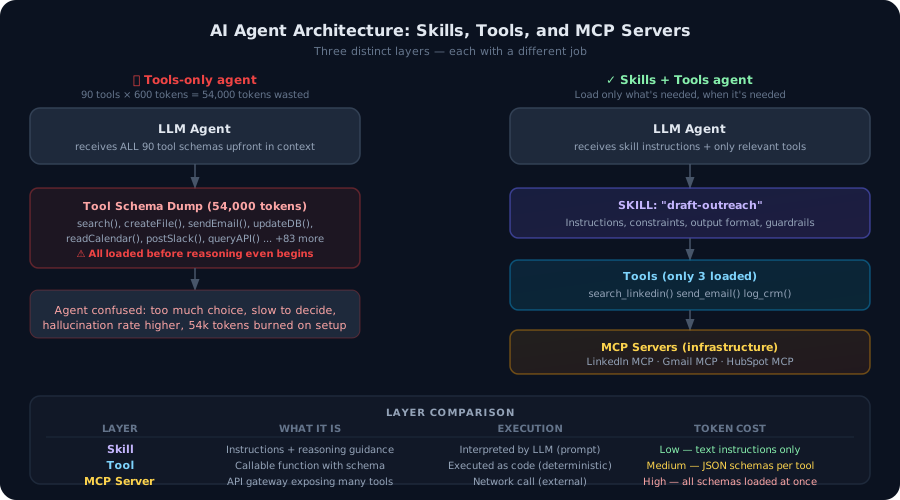
Most developers build agents with tools. That's not enough. Here's the architectural difference between agent tools and agent skills — and why getting this wrong burns tokens, degrades accuracy, and makes your agents brittle in production.
Vibe Coding Survival Guide
How to Ship AI-Assisted Code That Doesn't Embarrass You in Production
A production-minded guide for developers, founders, and teams using AI coding tools without letting brittle generated code reach customers.