


AI MVP Development: How to Build and Launch an AI MVP in 2026
Every week, a founder reaches out with the same situation: they have a real problem, a clear AI use case, and a budget — but they've lost three months building the wrong thing.
Usually, it's one of two failure modes. They tried to build too much — a full product when they needed a focused MVP. Or they picked the wrong AI approach — training a custom model when an API call would have done the job.
AI MVP development is not regular MVP development with some LLM calls bolted on. The constraints are different, the failure modes are different, and the iteration loop works differently. This guide covers the full process — from problem definition to a working product in market — with the specific decisions that determine whether you ship in 8 weeks or 8 months.
What Is AI MVP Development?
An AI MVP (Minimum Viable Product) is the smallest version of an AI-powered product that delivers enough value to real users to generate actionable feedback. It's not a demo, a prototype, or a proof of concept — it's a production-ready (if minimal) product that real users can use and that you can learn from.
The "AI" part changes the definition of minimum viable in one critical way: an AI feature that produces wrong, hallucinated, or inconsistent output is worse than no AI feature at all. Your MVP must ship AI that works reliably — even if the scope is narrow — not AI that sometimes works across a broad scope.
The distinction matters: a chatbot that correctly answers questions about your product documentation 95% of the time is a viable AI MVP. A chatbot that attempts to answer any question and is right 60% of the time is not.
Why Build an AI MVP Before Developing a Full Product?
Three reasons that apply specifically to AI products:
AI use cases are harder to validate on paper. With a traditional SaaS feature, you can sketch a UI and get meaningful user feedback in a Figma prototype. With an AI feature, you cannot evaluate whether the model output will actually be useful until users interact with it at scale. An MVP gets you to real usage faster.
AI costs are unpredictable at scale. A feature that costs $0.002 per user interaction at 100 users per day becomes $200/day at 100,000 interactions. You need production data on actual usage patterns before you can model your unit economics — and you can only get that data from a shipped product.
The model landscape is moving fast. An architecture decision you make today (RAG vs. fine-tuning, Claude vs. GPT-4o, embedding model choice) may be obsolete in six months. Shipping a focused MVP gets you learning before the ground shifts again.
What Types of AI Products Can Be Built as an MVP?
The AI MVP category is broad. Common types that are well-suited to MVP-first development:
- AI chatbots and assistants — customer support, internal knowledge base Q&A, sales qualification
- AI content generation tools — writing assistants, email drafters, SEO content generators
- AI document processing — contract analysis, invoice extraction, report summarisation
- AI recommendation engines — product recommendations, content personalisation
- AI-powered search — semantic search over internal docs or product catalogs
- AI copilots — coding assistants, workflow copilots embedded in existing tools
- AI data analysis — natural language querying of databases, automated reporting
- AI voice agents — phone-based customer service, intake forms, scheduling
The pattern that works for MVP: one well-defined AI capability, applied to a specific user workflow, solving a problem where the current alternative is manual and time-consuming.
Key Features to Include in an AI MVP
Core User Functionality
The non-AI features that make the product usable: authentication, the core user workflow, result display, and basic settings. These should be minimal but robust. A broken auth flow undermines trust in the AI output even if the AI is working perfectly.
AI Functionality
The specific AI feature(s) you're shipping. Be ruthless: pick one primary AI capability for the MVP. This is typically the thing that takes the most engineering effort and has the most uncertainty — do it first, do it well, and resist adding secondary AI features until the primary one is validated.
Data & Analytics
Track AI-specific metrics from day one: output acceptance rate (do users use what the AI produces?), query distribution, latency per request, error rate, and token spend per session. You cannot iterate on AI you cannot measure.
Security
AI products have specific security considerations beyond standard web app security: prompt injection protection, output filtering, rate limiting per user to control costs, PII detection before data is sent to the model, and clear handling of user data in your privacy policy.
AI and GPT-Driven MVP Development
GPT-4o, Claude, and Gemini have changed what's possible in an AI MVP timeline. In 2022, a text generation feature required fine-tuning a model, building a training pipeline, and managing inference infrastructure. In 2026, the same feature is an API call with a well-crafted prompt.
This compresses the MVP timeline dramatically. Features that previously required a dedicated ML engineer can now be built by a full-stack developer with good prompting skills. The constraint has shifted from "can we build this AI capability?" to "can we build a product around this AI capability that users will pay for?"
That said, API-based AI has its own constraints: latency (typically 1–5 seconds for a streaming response), cost (which scales with token volume), and dependency on the provider's uptime and model behaviour. Your MVP architecture needs to account for these from the start.
AI MVP Development Process: Step-by-Step
 AI MVP Development Process — 9 Steps from Problem to Scale
1. Define the Business Problem
Start with the problem, not the AI solution. What is the user doing manually today? How long does it take? What does it cost? What does a good outcome look like?
The clearest AI MVP opportunities have three properties: the task is well-defined (the correct output is recognisable), the task is repetitive (it happens frequently enough to matter), and the manual alternative is slow or expensive. If your use case doesn't have all three, validate more before building.
2. Validate the AI Use Case
Before writing a line of product code, run a technical proof of concept. Take 20–50 real examples of the input your system will receive and test whether the AI model produces acceptable output with a straightforward prompt. This takes one to two days and tells you whether your use case is solvable with current models.
This step prevents the most expensive mistake in AI MVP development: spending three months building an application layer for an AI capability that doesn't actually work reliably at the prompt level.
3. Define the MVP Scope
Three to five features maximum. Write them out explicitly and cut everything else. The scoping conversation is where most AI MVPs go wrong — the "while we're at it" additions that turn an 8-week project into a 6-month one.
Define your success metric before you build: what would make this MVP a clear win at week 8? If you can't define that now, the scope isn't clear enough yet.
4. Select the AI Technology
The primary decision tree:
API vs. fine-tuned model: For the vast majority of AI MVP use cases in 2026, a well-prompted frontier model via API (Claude, GPT-4o, Gemini) outperforms a fine-tuned smaller model. Fine-tuning makes sense when you need very consistent output format, domain-specific terminology at scale, or latency below 500ms. Start with API.
RAG vs. prompt-only: If your AI needs to answer questions about your specific data (documents, products, knowledge base), use RAG with a vector database. If it's a general capability (writing, summarisation, classification), start with prompt-only and add retrieval if needed.
Model choice: Claude (Anthropic) for instruction-following and structured output; GPT-4o for multimodal tasks; Gemini for Google ecosystem integration. Claude Haiku / GPT-4o-mini for high-volume, cost-sensitive use cases.
Vector database: Pinecone or pgvector (in Postgres) for RAG. Pgvector is simpler and cheaper at MVP scale.
5. Design the UX/UI
AI products have unique UX requirements that regular apps don't. Design for latency — streaming responses, skeleton loaders, and progress indicators are not optional; a blank screen for 3 seconds while the AI thinks will feel broken. Design for errors — what does the user see when the AI produces a bad output, times out, or fails entirely? Design for feedback — how do users signal that output was useful or not?
Figma wireframes first. Don't start building until the core flows are approved.
6. Develop the MVP
Recommended stack for AI MVPs in 2026:
- Frontend: Next.js 15 (App Router) — server components reduce AI latency by streaming from the server
- Backend: Node.js + TypeScript — async-first, excellent LLM SDK support
- AI layer: Vercel AI SDK or LangChain for streaming and tool use
- Database: PostgreSQL + pgvector for combined relational + vector storage
- Hosting: Vercel (frontend), Railway (backend workers and long-running jobs)
- Observability: LangSmith or Helicone for AI request logging and cost tracking
Use AI-assisted development (Cursor with Claude or GPT-4o) for the product code. This alone reduces development time by 30–50% for standard patterns — auth, CRUD, UI components — freeing your engineering time for the AI-specific logic.
7. Test the AI MVP
Standard software testing plus AI-specific testing:
- Functional testing — does the product work end to end?
- AI output quality testing — manually review 100+ AI outputs across diverse inputs; identify the failure modes
- Adversarial testing — what happens with malformed input, prompt injection attempts, very long inputs?
- Latency testing — what is the p95 latency under realistic load?
- Cost testing — what is the actual token spend per user session?
The AI output quality review is the one most teams skip. It's the most important. You will find failure modes in this step that automated tests won't catch.
8. Launch and Collect Feedback
Ship to a small, controlled group first — 10 to 50 users who understand they're using an early product. This is not a public launch. The goal is learning, not growth.
Track: which AI outputs do users actually use? Which do they discard or re-run? What queries are coming in that your system handles poorly? How much is each user session costing you in API spend?
The data from this phase drives your iteration decisions. Without it, you're guessing.
9. Iterate and Scale
Double down on the things the data shows are working. Fix the AI failure modes you discovered in production. Optimise prompts based on real query patterns. Only after the core AI capability is stable should you expand scope.
The move from MVP to full product happens when: the AI output quality is consistently good, users are returning and getting value, and you have a clear model for unit economics that works at scale.
AI MVP Technology Stack
The stack that consistently produces good AI MVPs in 2026:
| Layer | Technology | Why |
|---|---|---|
| Frontend | Next.js 15 | Streaming RSC, App Router, excellent DX |
| API / Backend | Node.js + TypeScript | Async-first, great LLM SDK ecosystem |
| AI Models | Claude (Anthropic) / GPT-4o | Best instruction-following, structured output |
| Orchestration | Vercel AI SDK / LangChain | Streaming, tool use, multi-step agents |
| Vector search | pgvector (Postgres) | Simpler ops than Pinecone at MVP scale |
| Database | PostgreSQL | Handles relational + vector in one system |
| Auth | Clerk or NextAuth | Ship auth in hours, not days |
| Hosting | Vercel + Railway | Zero-config, generous free tiers |
| AI observability | Helicone / LangSmith | Log every LLM call, track costs |
How Much Does It Cost to Develop an AI MVP in 2026?
Real ranges based on scope and complexity:
| Scope | Timeline | Cost Range |
|---|---|---|
| Simple AI MVP (1 AI feature, 3–5 pages, API-only) | 4–6 weeks | $30,000–$55,000 |
| Mid-complexity (RAG pipeline, multi-feature, integrations) | 8–12 weeks | $55,000–$140,000 |
| Full AI product (agents, custom data, multiple AI workflows) | 12–20 weeks | $140,000–$300,000+ |
Key cost drivers:
- RAG implementation adds 2–4 weeks vs. prompt-only (data ingestion, chunking, embedding pipeline, retrieval tuning)
- Custom AI agents with tool use and multi-step reasoning add significant complexity vs. single-turn completions
- Data preparation — if you have unstructured data that needs cleaning before it can be used for RAG or fine-tuning, budget 25–40% of the AI engineering time for this alone
- AI observability and guardrails — logging, cost tracking, output filtering — add 1–2 weeks but are non-optional for production
AI development tools (Cursor, Claude Code) reduce the labour component by 30–50% for standard product engineering, which is why the cost ranges above are lower than you might see from agencies quoting based on 2022-era development speeds.
How Long Does AI MVP Development Take?
- Simple AI MVP (one AI feature, API-based, minimal data requirements): 4–6 weeks
- Mid-complexity (RAG pipeline, multiple features, basic integrations): 8–12 weeks
- Full AI product MVP (agents, custom data ingestion, complex workflows): 12–20 weeks
The timeline killer is data. If you need to ingest, clean, and embed a large document corpus before your RAG pipeline works, add 2–4 weeks minimum. "We have all the data ready" almost never means the data is actually ready.
Build vs. Buy AI Components for an MVP
Using Existing AI APIs
The right default for 90% of AI MVPs. Claude, GPT-4o, and Gemini give you state-of-the-art capabilities via API with no model training, no infrastructure management, and predictable pricing. The tradeoff: your AI performance is bounded by what the frontier models can do, and you're dependent on provider uptime and pricing changes.
For most MVP use cases — chatbots, content generation, document processing, classification — this is not a constraint. The models are good enough, often dramatically better than what a fine-tuned smaller model would produce.
Building Custom AI Models
Almost never the right choice for an MVP. Training a custom model requires labelled training data (which you don't have at MVP stage), ML infrastructure, model evaluation expertise, and 2–4× more development time. The resulting model will typically underperform a prompted frontier model on most tasks.
Reserve custom model training for when: you have a unique task that frontier models handle poorly, you have enough high-quality labelled data (typically 10,000+ examples), and you have a clear inference latency or cost requirement that APIs can't meet.
Fine-Tuning Existing Models
The middle ground. Fine-tuning a model like GPT-4o-mini on your specific domain data can improve consistency and reduce prompt complexity for high-volume, well-defined tasks. Makes sense when:
- You're running millions of similar completions per day and cost matters
- Output format consistency is critical (structured data extraction, specific schemas)
- You need sub-500ms latency that streaming can't provide
For an MVP, the data collection and labelling process required for effective fine-tuning is itself a significant investment. Build with API first, fine-tune when you have production data to train on.
Common Challenges in AI MVP Development
Prompt brittleness. A prompt that works well on your test cases breaks on real user inputs. The fix: test with diverse, adversarial inputs before launch, not after.
Latency expectations. Users conditioned by sub-100ms web interactions find 2–3 second AI response times frustrating. Streaming (showing tokens as they're generated) is not optional — it's the difference between "fast" and "broken" in user perception.
Cost blow-ups. A single user triggering a multi-step agent pipeline with large context windows can generate $0.50–$2.00 of API cost in one session. Set hard token limits and cost alerts from day one.
Hallucination in production. The model performs well on your test cases, then confidently produces wrong information for a real user. RAG with source citations, output validation, and human-review workflows for high-stakes outputs are your defences.
Scope creep from AI capabilities. Once you have an LLM integration, it's tempting to add "just one more" AI feature. Resist. Finish and validate the core feature before expanding.
How to Measure the Success of an AI MVP
Product KPIs
- Activation rate — what percentage of users who sign up complete the core AI workflow?
- AI output acceptance rate — what percentage of AI outputs do users actually use (vs. discard or regenerate)?
- Retention — do users come back? Are they doing more AI sessions per week over time?
- NPS / qualitative feedback — are users telling you the AI saves them meaningful time?
AI Performance Metrics
- Latency — p50, p95, p99 response time per AI request
- Error rate — percentage of AI requests that fail or time out
- Cost per session — total API spend divided by user sessions
- Output quality score — manual review of a random sample of outputs each week
Track these from day one. The cost per session metric is particularly important — it's the foundation of your unit economics model.
When Should You Move From an AI MVP to a Full Product?
The MVP-to-product transition is warranted when:
- AI output quality is consistently good — your manual review shows <5% problematic outputs
- Users are retained — week-2 and week-4 retention are positive
- The unit economics work — cost per active user is a fraction of what users will pay
- You have a repeatable acquisition story — you know where your users come from and why they choose you
Don't expand scope because you've shipped the MVP and the first users liked it. Expand when the data supports it — when you've found product-market fit on the narrow scope and have clear evidence that more features would drive more value.
How to Choose an AI MVP Development Company
What separates a good AI MVP partner from a typical web agency:
They understand AI-specific failure modes. Can they explain prompt injection, context window management, hallucination mitigation, and RAG architecture? If the technical conversation sounds generic, they don't have real AI production experience.
They default to APIs, not custom models. A partner who immediately proposes fine-tuning or training custom models for an MVP is either behind the times or trying to scope a larger engagement than you need.
They track AI costs from day one. LLM costs can make or break a business. A good partner instruments cost tracking before they write the first product feature.
They have production AI references. Not demos. Not prototypes. Ask to speak with a founder whose AI product is live, serving real users, and generating revenue.
Final Thoughts
The best AI MVPs in 2026 share a pattern: a narrow, well-defined AI capability, applied to a specific user workflow, shipped to real users in 6–12 weeks, and iterated based on production data.
The worst AI MVPs share a different pattern: an ambitious AI vision, a broad feature scope, six months of development without real user feedback, and a launch that reveals the core AI capability doesn't work reliably in the wild.
The process in this guide is designed to get you to the first pattern. Prove the AI capability in a proof of concept before you build the product. Scope to the minimum. Ship to real users. Measure. Iterate.
If you're building an AI product and want to get from idea to a working MVP without the common detours, let's talk — I work with founders at exactly this stage.
Frequently Asked Questions
What is AI MVP development?
AI MVP development is the process of building the smallest viable version of an AI-powered product that can be tested with real users. The goal is to validate whether the core AI capability delivers enough value to justify building a full product — in the minimum time and at the minimum cost.
How much does it cost to develop an AI MVP?
A simple AI MVP (one AI feature, API-based, minimal data requirements) typically costs $30,000–$55,000 and takes 4–6 weeks. Mid-complexity AI MVPs with RAG pipelines and multiple features run $55,000–$140,000 over 8–12 weeks. Full AI product MVPs with agents and complex workflows range from $140,000–$300,000+.
How long does it take to build an AI MVP?
4–6 weeks for a simple AI MVP using existing AI APIs. 8–12 weeks for mid-complexity projects including RAG and integrations. 12–20 weeks for complex AI products with multiple workflows and agents. Data preparation is the most common timeline extender — if you have unstructured data to clean and embed, add 2–4 weeks.
What is the difference between an MVP and an AI MVP?
A traditional MVP validates whether users want the product. An AI MVP also validates whether the AI capability works reliably for real users with real inputs — which cannot be evaluated in a prototype or Figma mockup. AI MVPs require production deployment to test because AI output quality is dependent on real usage patterns.
Can I build an AI MVP using GPT?
Yes. GPT-4o and GPT-4o-mini via the OpenAI API are a solid foundation for most AI MVP use cases. For instruction-following and structured output, Claude (Anthropic) often outperforms GPT-4o. The choice of model matters less than the quality of your prompt design, your RAG implementation (if applicable), and your product UX.
What technologies are used to develop AI MVPs?
The standard 2026 stack: Next.js (frontend), Node.js + TypeScript (backend), Claude or GPT-4o (AI model), Vercel AI SDK or LangChain (orchestration), PostgreSQL + pgvector (database and vector search), Vercel + Railway (hosting), and Helicone or LangSmith (AI observability).
Should I use an existing AI model or build a custom model?
Use an existing model via API (Claude, GPT-4o, Gemini) for your MVP. In 2026, frontier models via API outperform custom-trained models for most use cases, with no training data requirement, no ML infrastructure, and dramatically faster time to market. Build or fine-tune a custom model when you have production data, clear performance requirements that APIs can't meet, and the volume to justify the investment.
How do I choose an AI MVP development company?
Look for production AI experience (live products, not demos), API-first thinking (skepticism of custom models for MVPs), AI cost instrumentation from day one, and references from founders with shipped AI products. Avoid agencies that treat AI development as standard web development with LLM calls added — the failure modes are different and require specific experience to navigate.
Stuck on a web app, automation, or AI project?
Fifteen minutes, free. You describe the blocker, I tell you what I would fix first. No deck, no pitch — and if I am not the right fit, I will say so.
Book Your Free 15-Min Strategy CallRelated to: AI MVP Development: How to Build and Launch an AI MVP in 2026If you found this article helpful, consider buying me a coffee to support more content like this.
Related Articles

AI workflow automation uses AI agents to automate multi-step business processes that traditional automation can't handle. Learn how it works, where it adds value, and how to build it.
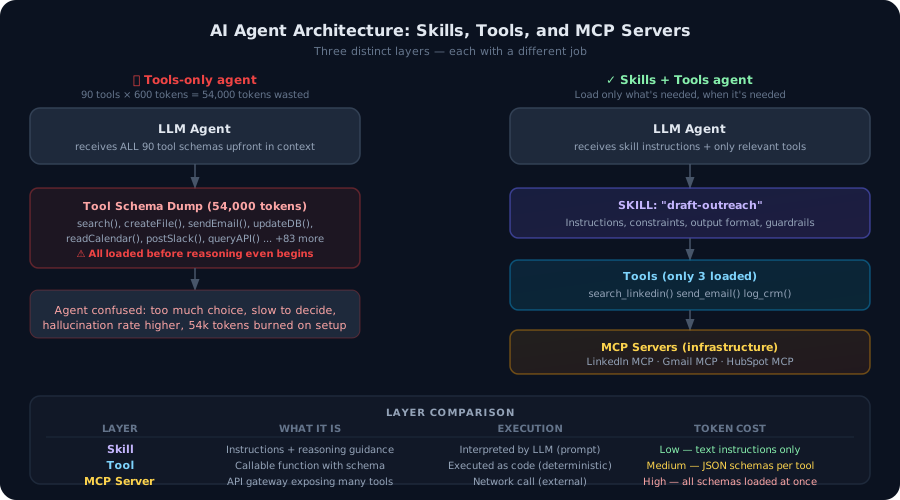
Most developers build agents with tools. That's not enough. Here's the architectural difference between agent tools and agent skills — and why getting this wrong burns tokens, degrades accuracy, and makes your agents brittle in production.
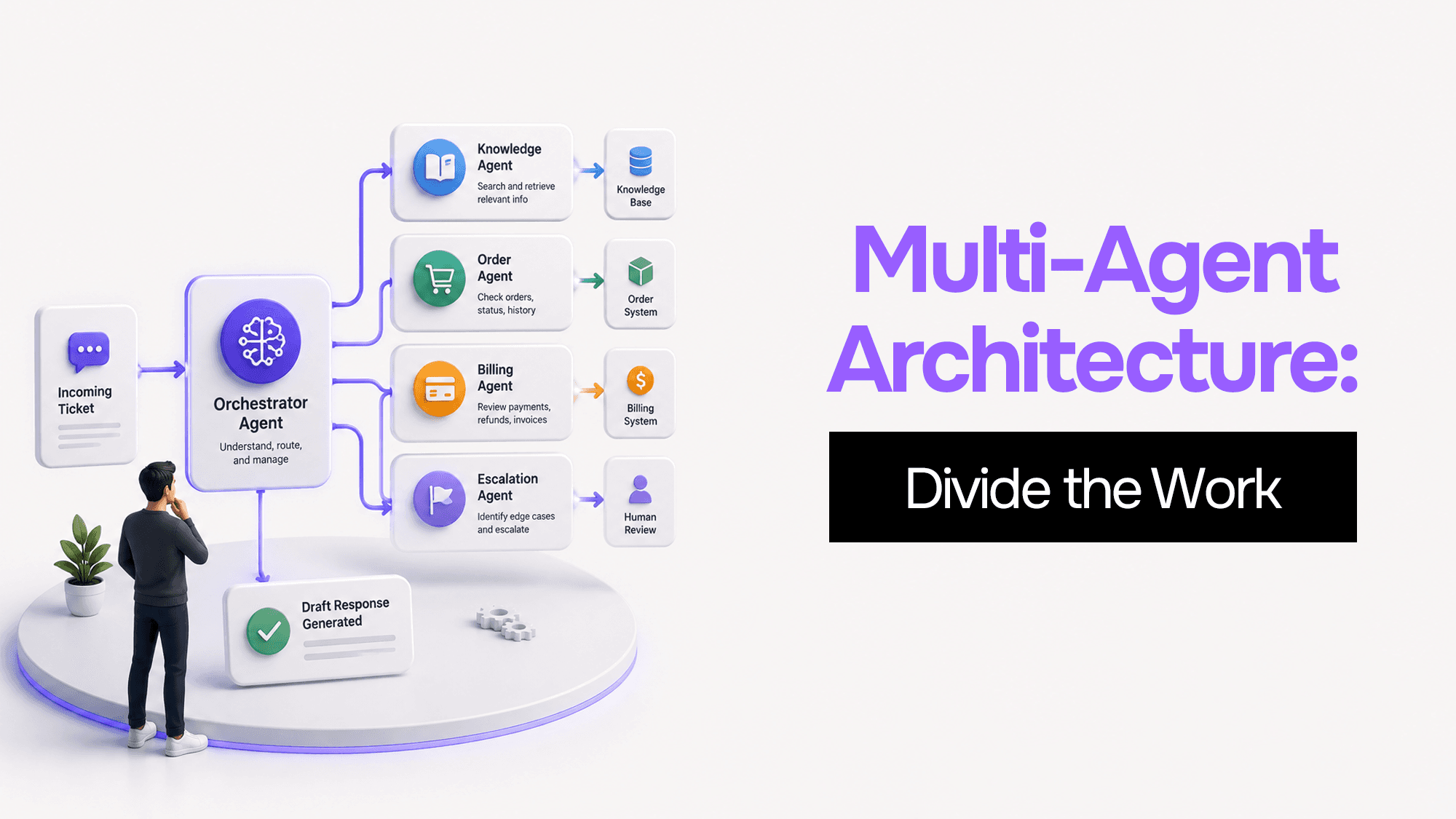
You built one AI agent and it worked. Then it got slower, started forgetting things, and ended up with access to databases it shouldn't touch. Here's what's actually happening — and four coordination patterns to fix it.
Stuck on a web app, automation, or AI project?
Fifteen minutes, free. You describe the blocker, I tell you what I would fix first. No deck, no pitch — and if I am not the right fit, I will say so.
Book Your Free 15-Min Strategy CallRelated to: AI MVP Development: How to Build and Launch an AI MVP in 2026