

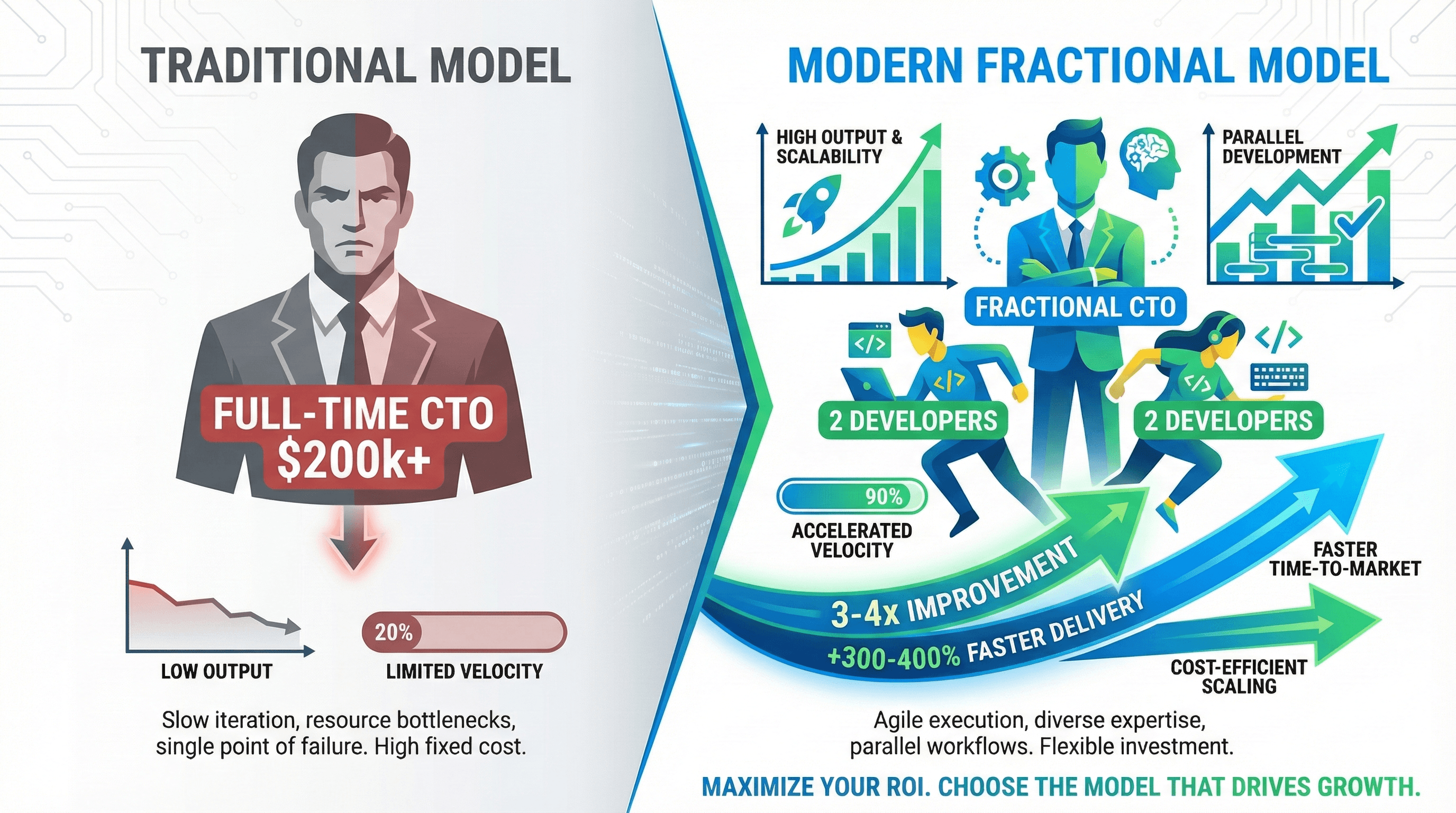
Why Hiring a Full-Time CTO Too Early Is a $200k Mistake
Executive Summary
There is a predictable moment in every seed-stage startup's life. You have raised your first round of funding, or you are getting serious about your MVP. You look at your org chart, see an empty box labeled "CTO," and think: "I need to hire a seasoned executive to fill this."
You go out and find a veteran with 15 years of experience. You pay them $200,000+ per year and give them 5% equity. You feel like you have "leveled up."
Six months later, you realize the trap: You hired a manager, but you needed a builder.
Your new CTO is great at creating slide decks and "building culture," but they have not written code in 5 years. Meanwhile, your product is stalled because you spent your entire engineering budget on one salary.
For 90% of startups, hiring a full-time CTO before Series A is financial suicide. You do not need a full-time executive. You need Fractional Strategy and Full-Time Execution.
The Math: "C-Level Title" vs. "The Builder-Leader"
Let's break down the economics of the early-stage engineering budget.
Scenario A: The Full-Time CTO
| Cost Component | Annual Impact |
|---|---|
| Base Salary | $200,000 - $280,000 |
| Equity Grant | 1% - 5% (worth $50k - $500k at exit) |
| Benefits & Overhead | $30,000 - $40,000 |
| Recruiter Fee (if used) | $40,000 - $56,000 (20% of salary) |
| Total First-Year Cost | $270,000 - $376,000 |
Daily Output:
- Meetings: 60% of time
- Hiring plans and culture decks: 20% of time
- Vendor calls and board prep: 15% of time
- Code shipped: Near Zero
Result: You have "strategy" but no product. Your runway shrinks by 25-30% with minimal velocity.
Scenario B: The Fractional CTO Model
| Cost Component | Annual Impact |
|---|---|
| Fractional CTO (10 hrs/week) | $60,000 - $96,000 |
| 2x Senior Developers | $144,000 - $180,000 |
| Total First-Year Cost | $204,000 - $276,000 |
Daily Output:
- Fractional CTO sets architecture and reviews code (10 hrs/week)
- Senior Devs build features (80 hrs/week combined)
- Code shipped: High Velocity
Result: You get the same strategic safety, but you actually launch the product.
Cost Savings: $66,000 - $100,000 in Year 1 Velocity Gain: 3-5x more code shipped Runway Extension: 3-6 additional months
The Hidden Trap: Strategy Without Execution
Here is what happens in the typical early-stage CTO hire:
Month 1-2: The Honeymoon
Your new CTO audits the tech stack, meets the team, creates a "technical roadmap." Everything feels productive.
Month 3-4: The Reality
The roadmap is beautiful, but no code is being written. The CTO is in back-to-back meetings. Your existing developers are confused about priorities.
Month 5-6: The Crisis
You realize you spent $100k and your product has not moved. Your investors start asking questions. Your runway is shrinking faster than your user growth.
Month 7-8: The Pivot
You either:
- Hire more developers (but now your budget is gone)
- Ask the CTO to write code (but they are rusty and slow)
- Realize you need to restructure (expensive and time-consuming)
The pattern is predictable. The outcome is avoidable.
When Do You Actually Need a Full-Time CTO?
A full-time CTO is a "People Problem" solver, not a "Product Problem" solver. You need one when:
✅ You Should Hire a Full-Time CTO If:
- You have 10+ engineers and communication is breaking down across teams
- Your cloud spend is $50k+/month and you need dedicated infrastructure optimization
- You are scaling to Series B/C and need board-level technical leadership
- You have complex compliance requirements (HIPAA, SOC 2, PCI) that need full-time oversight
- You are in the middle of M&A and need executive-level technical due diligence
❌ You DO NOT Need a Full-Time CTO If:
- You are building an MVP or finding product-market fit
- You have fewer than 5 engineers
- Your primary need is "someone to write good code"
- You are pre-Series A with limited runway
- Your monthly burn rate is under $100k
If you are in the second category, a Fractional CTO is the right move.
The Solution: Rent the Strategy, Buy the Execution
The smartest founders I work with use a Hybrid Model that optimizes for both velocity and cost.
The Three-Layer Architecture
Layer 1: The Architect (Fractional CTO)
Time Investment: 10-15 hours per week Responsibilities:
- Design database schema and architecture
- Choose tech stack (AWS vs GCP, PostgreSQL vs MongoDB)
- Set up CI/CD pipelines and deployment infrastructure
- Review critical code and architectural decisions
- Mentor senior developers on best practices
Cost: $5,000 - $8,000 per month
Layer 2: The Builders (Full-Time Senior Developers)
Time Investment: 40 hours per week each Responsibilities:
- Ship features daily
- Write clean, maintainable code
- Implement the architecture designed by Layer 1
- Own specific product domains
Cost: $6,000 - $9,000 per month per developer
Layer 3: The Safety Net (Monthly Code Reviews)
Time Investment: 5-10 hours per month Responsibilities:
- Deep code reviews to catch technical debt early
- Unblock complex technical problems
- Ensure architecture stays consistent
- Train team on new patterns and tools
Cost: Included in fractional engagement
Total Monthly Cost: $17,000 - $25,000 Output: High-velocity product development with strategic oversight Runway Impact: 30-40% more efficient than full-time CTO model
Real-World Case Study: SaaS Startup
The Problem
A seed-stage B2B SaaS company raised $1.2M. They hired a full-time CTO at $220k + 3% equity. After 6 months:
- CTO spent 80% of time in meetings and planning
- Product velocity: 2 small features shipped
- Runway remaining: 8 months (critical zone)
- Team morale: Low (developers felt blocked)
The Pivot
They restructured to the Fractional Model:
- Transitioned CTO to advisor role (0.5% equity retained)
- Hired me as Fractional CTO (10 hrs/week)
- Hired 2 senior developers with the saved budget
The Results (6 Months Later)
- Product velocity: 15+ features shipped
- Runway extension: 14 months (6-month gain)
- Team morale: High (developers feel productive)
- Investor confidence: Strong (visible traction)
- Cost savings: $85,000 in first year
Key Insight: They got better strategic guidance AND faster execution by separating the roles.
The ROI Breakdown: 18-Month Comparison
Traditional Full-Time CTO Model
| Period | Salary | Benefits | Recruiting | Total | Features Shipped |
|---|---|---|---|---|---|
| Months 1-6 | $100k | $15k | $40k | $155k | 2-3 |
| Months 7-12 | $100k | $15k | - | $115k | 3-5 |
| Months 13-18 | $100k | $15k | - | $115k | 4-6 |
| Total | $385k | 9-14 features |
Fractional CTO + Builders Model
| Period | Fractional | 2x Devs | Total | Features Shipped |
|---|---|---|---|---|
| Months 1-6 | $36k | $72k | $108k | 8-10 |
| Months 7-12 | $36k | $72k | $108k | 12-15 |
| Months 13-18 | $36k | $72k | $108k | 15-20 |
| Total | $324k | 35-45 features |
Savings: $61,000 over 18 months Velocity Improvement: 3-4x more features shipped Runway Extension: 4-6 months
How to Structure a Fractional CTO Engagement
If you decide the Fractional Model is right for your startup, here is how to set it up for success:
Week 1: Technical Audit
- Review existing codebase and infrastructure
- Identify technical debt and security risks
- Assess team capabilities and gaps
- Document current architecture
Week 2-3: Strategic Foundation
- Define tech stack and architectural patterns
- Set up CI/CD and deployment pipelines
- Create engineering standards and best practices
- Establish code review processes
Week 4+: Ongoing Partnership
- Weekly (2-3 hours): Architecture reviews, technical decision-making
- Bi-weekly (2-3 hours): Code reviews and technical mentorship
- Monthly (3-4 hours): Strategic planning and roadmap alignment
- On-demand: Unblocking critical technical issues
Success Metrics to Track
- Velocity: Features shipped per sprint
- Quality: Bug rate and technical debt reduction
- Team growth: Developer skill progression
- Runway: Burn rate optimization
- Time-to-market: MVP launch timeline
Common Objections (Answered)
"But we need someone full-time to build company culture"
Reality: Culture is built by the entire team, not one person. A Fractional CTO can establish technical culture and standards without being physically present 40 hours per week.
"Our investors expect us to have a CTO on the team"
Reality: Investors care about velocity and burn rate. Show them you are shipping faster and spending less with a Fractional model. That is what matters.
"What if our Fractional CTO works with competitors?"
Reality: Professional Fractional CTOs have strict non-compete and NDA clauses. They also bring cross-industry experience that benefits your product.
"We need someone to manage our developers day-to-day"
Reality: If you need daily management, hire an Engineering Manager ($120k-$150k) plus a Fractional CTO for strategy. Still cheaper than a full-time CTO and more effective.
The Decision Framework
Choose Fractional CTO If:
- Pre-Series A with limited runway
- Team size: 1-8 engineers
- Monthly burn rate: Under $150k
- Primary need: Architecture, velocity, strategic guidance
- You want to extend runway while shipping faster
Choose Full-Time CTO If:
- Post-Series A with significant runway
- Team size: 10+ engineers
- Monthly burn rate: $200k+
- Primary need: Executive leadership, board presentations, organizational scaling
- You have complex compliance or regulatory requirements
The Verdict
Your investors do not care if you have a CTO on LinkedIn. They care if you have:
- A product that works
- Users that are growing
- A burn rate that makes sense
- A team that ships consistently
The math is simple:
- Save $60k - $100k per year
- Ship 3-4x more features
- Extend runway by 4-6 months
- Reduce hiring risk and complexity
Do not burn your runway on a title. Invest in output.
The question is not whether the Fractional Model works. The question is whether you can afford to ignore it.
Ready to Optimize Your Technical Leadership?
I act as a Fractional CTO for seed-stage startups that need high-level architecture, strategic guidance, and team mentorship without the full-time burn rate.
What you get:
- ✅ Technical architecture and stack decisions
- ✅ CI/CD setup and infrastructure design
- ✅ Code reviews and technical mentorship
- ✅ Strategic roadmap and technical due diligence
- ✅ On-demand problem solving and unblocking
What you save:
- 💰 $60k - $100k per year in costs
- ⏱️ 3-6 months of runway extension
- 🚀 3-4x velocity improvement
Let's build your technical foundation the smart way.
Get Started:
- Book a Fractional Strategy Call
- View My Engineering Solutions at Eunix Tech
- Follow me on Twitter
- Connect on LinkedIn
If you enjoyed this article, consider supporting my work:
Stuck on a web app, automation, or AI project?
Fifteen minutes, free. You describe the blocker, I tell you what I would fix first. No deck, no pitch — and if I am not the right fit, I will say so.
Book Your Free 15-Min Strategy CallRelated to: Why Hiring a Full-Time CTO Too Early Is a $200k MistakeIf you found this article helpful, consider buying me a coffee to support more content like this.
Related Articles

Harden a Replit app for production: a checklist covering authentication, secrets, database separation, deployment type, backups and monitoring before launch.
The security requirements for deploying autonomous AI agents in production: identity, least privilege, prompt injection defenses, human approval, audit logs, and more, mapped to OWASP and NIST guidance.
The eight metrics to track after implementing AI workflow automation, how to measure each one, and how to turn them into a payback number your team trusts.
Stuck on a web app, automation, or AI project?
Fifteen minutes, free. You describe the blocker, I tell you what I would fix first. No deck, no pitch — and if I am not the right fit, I will say so.
Book Your Free 15-Min Strategy CallRelated to: Why Hiring a Full-Time CTO Too Early Is a $200k Mistake