

Stop Hunting for Rockstars: Why Mentorship Is Your Best Engineering Investment
Executive Summary
Every startup founder has the same wish list: "I need a Senior Engineer. Someone who can hit the ground running, architect the whole system, and does not need hand-holding."
Here is the hard truth: Everyone is looking for that person. And because supply is low and demand is infinite, you will overpay, wait 6 months to find them, and watch them leave for a better offer 8 months later.
The most profitable engineering teams do not just buy talent. They build it.
In my experience mentoring hundreds of developers, I have seen a clear pattern: A mid-level developer with the right mentorship structure will outperform a "Rockstar" within 6 months—at half the cost and with 3x the loyalty.
The Financial Trap of the "Senior Hire"
Let's look at the math that most Engineering Managers ignore.
Option A: The Senior Hire Strategy
| Cost Component | Annual Impact |
|---|---|
| Base Salary | $150k - $250k+ |
| Recruiter Fee (20%) | $30k - $50k (one-time) |
| Ramp-up Time | 3 months at reduced productivity |
| Retention Risk | 65% leave within 18 months |
| Total First-Year Cost | $200k - $320k |
Hidden costs:
- Opportunity cost during 4-6 month search period
- Interview time from your existing team (20-30 hours minimum)
- Culture mismatch risk (1 in 3 senior hires do not fit)
Option B: The Mentorship Investment Model
| Cost Component | Annual Impact |
|---|---|
| Mid-Level Salary | $80k - $120k |
| Mentorship Time (5 hrs/week) | $15k - $20k (senior's allocated time) |
| Ramp-up Time | 3-6 months with structured support |
| Retention Rate | 85%+ stay beyond 2 years |
| Total First-Year Cost | $95k - $140k |
ROI Benefits:
- Save $105k - $180k per year per developer
- Build institutional knowledge instead of renting it
- Create a scalable growth model, not a hiring treadmill
The "Senior Hire" is a capex gamble. The "Mentorship Model" is a compounding investment.
The Hidden Cost You Cannot See: The Bus Factor
Beyond the salary, relying on "Rockstars" creates a dangerous structural weakness in your company: The Bus Factor.
If you have one genius who knows how the deployment pipeline works, you do not have a team; you have a hostage situation. If that person gets hit by a bus (or gets a job at Google), your company stops moving.
Real-world impact:
- Average time to replace critical knowledge: 6-12 months
- Revenue impact during knowledge gap: 15-30% velocity loss
- Emergency contractor costs: $200-$400/hour
Mentorship forces documentation. You cannot mentor someone if the knowledge is locked in one person's head. By building a culture where knowledge is shared, you immunize your company against turnover.
How to Build a "10x Team" (Not 10x Engineers)
Mentorship is not just "letting them ask questions." That is a distraction. Effective mentorship is a system.
Based on my work with teams and on platforms like Codementor, here is the structure that actually works:
1. The "Unblocking" Protocol
Junior developers do not waste time because they are slow typists. They waste time because they get stuck on a specific error for 4 hours.
The Fix: Implement a "15-Minute Rule." If you are stuck for 15 minutes, you must ask for help.
ROI:
- Reduces wasted debugging time by 60-70%
- Turns "stuck time" into "learning time"
- Increases daily code velocity by 40%
2. Code Reviews as Classrooms
Most code reviews are just "Gatekeeping" (fixing typos and enforcing style).
The Fix: A high-value code review explains why.
- ❌ Bad: "Don't use a loop here"
- ✅ Good: "Using a map here reduces complexity from O(n²) to O(n), which matters when this function runs 1000x per request"
ROI:
- Developers learn patterns, not just fixes
- Reduces repeated mistakes by 80%
- Builds critical thinking skills
3. Pair Programming on "Scary" Tasks
Do not give the easy bugs to the juniors. Give them the hard bugs, but have a senior developer navigate.
The Structure:
- Junior drives (writes code)
- Senior navigates (explains architecture decisions)
- 2 hours per week minimum
ROI:
- Junior learns core system architecture in weeks, not months
- Senior learns how to explain their thinking (leadership skill)
- Both improve, knowledge spreads
4. Weekly "Architecture Office Hours"
Set aside 1 hour per week where anyone can ask "why" questions about system design.
Common questions:
- "Why did we choose PostgreSQL over MongoDB?"
- "Why do we use Redis for caching?"
- "Why microservices instead of a monolith?"
ROI:
- Prevents architectural drift
- New hires understand the "why" behind decisions
- Creates a culture of documentation
The CEO/CTO Decision Framework
You Should Invest in Mentorship If:
- Your engineering team is 5+ people and growing
- Your bus factor is 1-2 people on critical systems
- You spend 40%+ of hiring budget on recruiting fees
- Your average developer tenure is under 18 months
- You need to scale velocity without proportional headcount growth
You Can Keep Hiring "Rockstars" If:
- You have unlimited budget and are competing with FAANG
- You operate in a low-complexity domain (simple CRUD apps)
- You are okay with high churn and knowledge loss
- You do not plan to scale beyond 10 engineers
The Real Numbers: Mentorship ROI
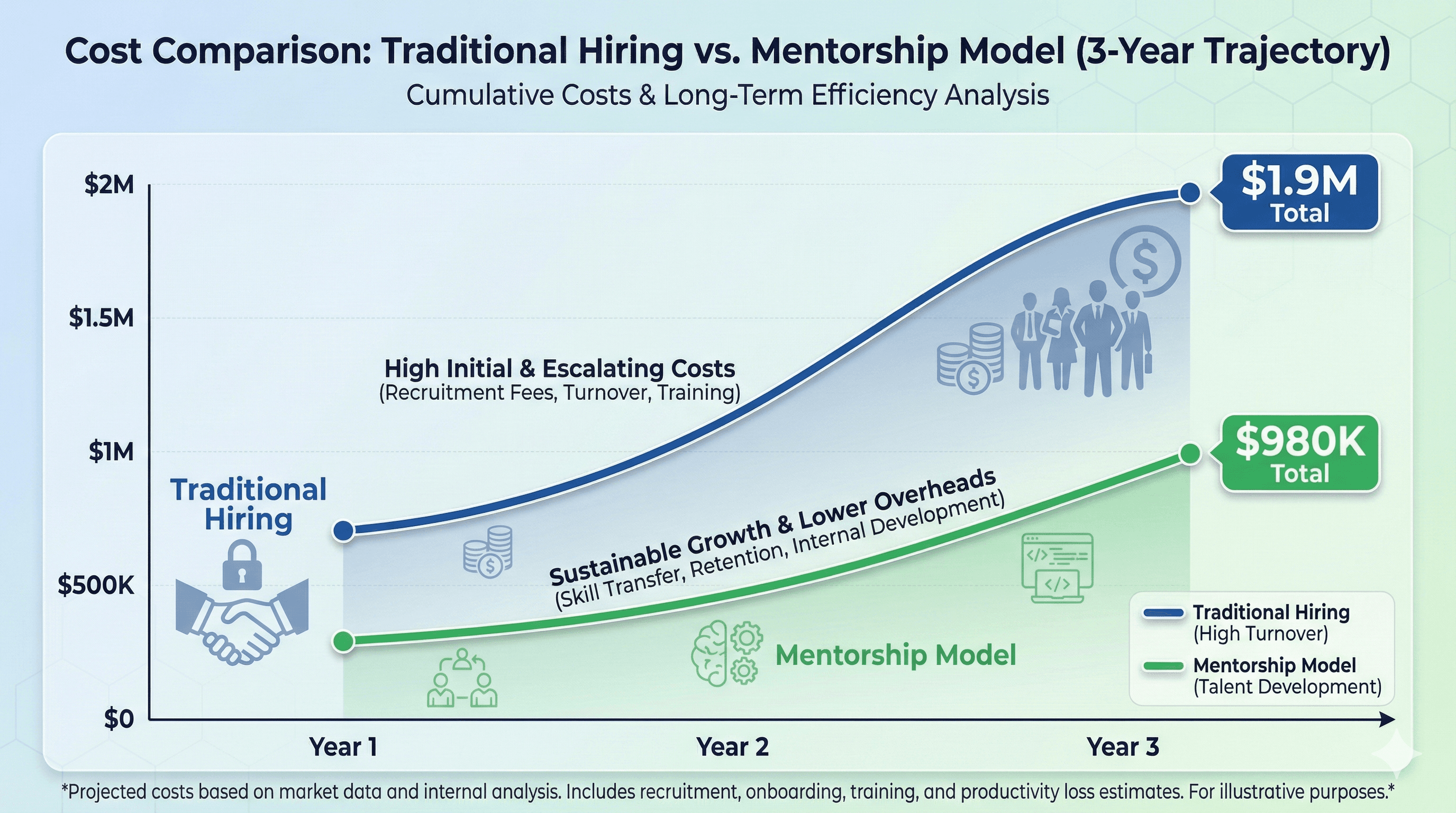
Let's run the 3-year math on a 10-person engineering team.
Traditional "Rockstar" Hiring Model
| Year | Hiring Cost | Turnover Cost | Total |
|---|---|---|---|
| Year 1 | $400k (2 hires) | - | $400k |
| Year 2 | $600k (3 hires) | $200k (2 replacements) | $800k |
| Year 3 | $400k (2 hires) | $300k (3 replacements) | $700k |
| 3-Year Total | $1.9M |
Mentorship Investment Model
| Year | Hiring Cost | Mentorship Cost | Turnover Cost | Total |
|---|---|---|---|---|
| Year 1 | $200k (2 mid-levels) | $40k | - | $240k |
| Year 2 | $300k (3 mid-levels) | $60k | $50k (1 replacement) | $410k |
| Year 3 | $200k (2 mid-levels) | $80k | $50k (1 replacement) | $330k |
| 3-Year Total | $980k |
Three-year savings: $920k
That is nearly $1M you can reinvest in product, marketing, or infrastructure—not recruiting fees.
How to Start Tomorrow
You do not need to overhaul your entire organization. Start small.
Week 1:
- Identify your "Bus Factor 1" systems
- Assign a mid-level developer to shadow the expert
- Implement the 15-Minute Rule
Week 2-4: 4. Start weekly architecture office hours 5. Convert code reviews into teaching moments 6. Schedule 2 hours of pair programming per week
Month 2-3: 7. Measure velocity improvements 8. Track unblocking time reduction 9. Survey developer satisfaction
Month 6: 10. Calculate ROI: hiring costs saved, velocity gained, retention improved 11. Scale the model across the team
The Verdict
You can keep trying to outbid Big Tech for the top 1% of developers. Or, you can hire the top 20%—the hungry, smart, capable developers—and build the infrastructure to turn them into the top 1%.
The former is a hiring strategy. The latter is a business strategy.
The math is simple:
- Lower hiring costs
- Higher retention rates
- Faster team scaling
- Reduced bus factor risk
- Compounding knowledge growth
The question is not whether mentorship works. The question is whether you can afford not to invest in it.
Struggling to Scale Your Team?
I do not just write code; I help companies build the engineering culture that writes better code, faster. Whether you need a fractional mentor, a strategy audit, or help building your mentorship program, let's talk.
Resources:
- Book a Strategy Call
- View My Mentorship Profile on Codementor
- Follow me on Twitter
- Connect on LinkedIn
If you enjoyed this article, consider supporting my work:
Stuck on a web app, automation, or AI project?
Fifteen minutes, free. You describe the blocker, I tell you what I would fix first. No deck, no pitch — and if I am not the right fit, I will say so.
Book Your Free 15-Min Strategy CallRelated to: Stop Hunting for Rockstars: Why Mentorship Is Your Best Engineering InvestmentIf you found this article helpful, consider buying me a coffee to support more content like this.
Related Articles

The eight metrics to track after implementing AI workflow automation, how to measure each one, and how to turn them into a payback number your team trusts.
Harden a Replit app for production: a checklist covering authentication, secrets, database separation, deployment type, backups and monitoring before launch.
The security requirements for deploying autonomous AI agents in production: identity, least privilege, prompt injection defenses, human approval, audit logs, and more, mapped to OWASP and NIST guidance.
Stuck on a web app, automation, or AI project?
Fifteen minutes, free. You describe the blocker, I tell you what I would fix first. No deck, no pitch — and if I am not the right fit, I will say so.
Book Your Free 15-Min Strategy CallRelated to: Stop Hunting for Rockstars: Why Mentorship Is Your Best Engineering Investment