

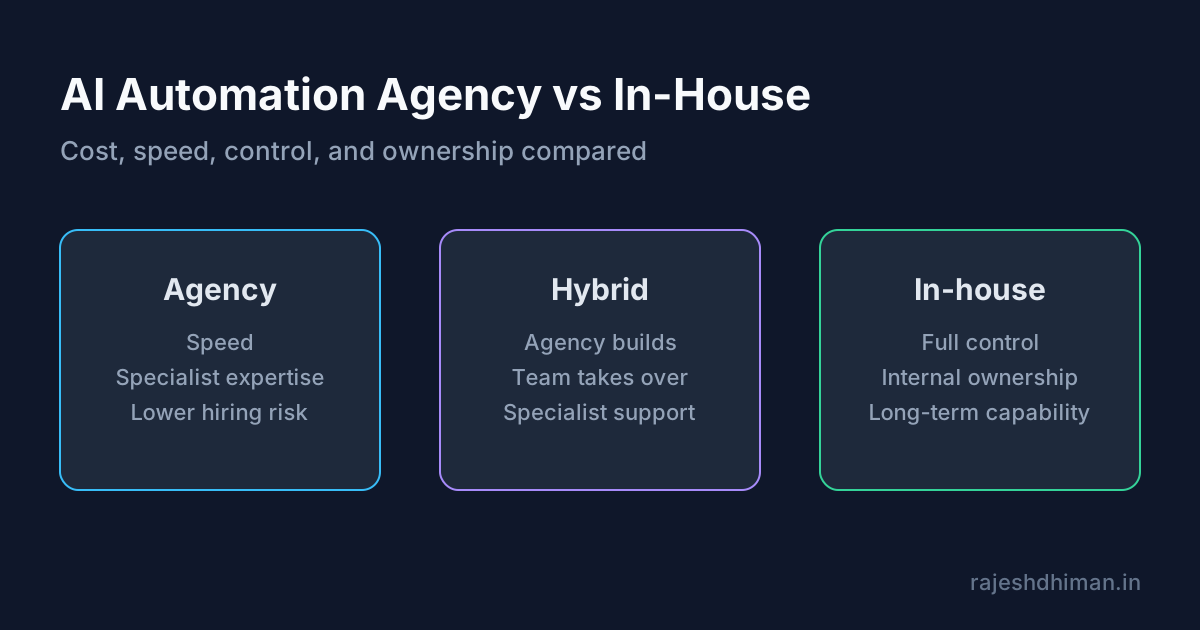
AI Automation Agency vs In-House Development: Which Approach Is Right for Your Business?
Almost every business I talk to now agrees that AI automation is useful. The hard question has moved on. It is no longer whether to automate, but how: hire an AI automation agency, build the capability in-house, or do some mix of the two.
Both paths can work, and both can fail expensively. This guide compares them honestly on speed, cost, control, risk, and long-term ownership, so you can decide based on your situation instead of on whoever is selling to you.
The work people usually want automated looks like this:
- Customer support replies
- Lead qualification
- Data entry
- Reporting
- Email processing
- CRM updates
- Document processing
- Internal operations
The right approach depends on your budget, technical expertise, workflow complexity, security requirements, and long-term goals. There is also a hybrid path, which I cover below.
What Is an AI Automation Agency?
An AI automation agency is an outside team that designs, builds, and maintains AI-powered workflows for other businesses. You bring a problem. They bring the people, tools, and experience to solve it.
What Does an AI Automation Agency Do?
A good one looks at how work actually flows, finds where automation pays off, builds it, connects it to your systems, tests it, and keeps it running.
AI Automation Agency vs Traditional Automation Company
A traditional automation company mostly wires together fixed rules. An AI automation agency adds models that can read unstructured input and make bounded decisions, such as classifying an email or extracting fields from a document.
AI Automation Agency vs AI Software Development Company
A software development company builds products. An automation agency usually focuses on workflows inside an existing business. The skills overlap, and some firms do both. Check which one you are actually buying.
What Types of Business Processes Can an AI Automation Agency Automate?
- AI-powered workflows
- API integrations
- CRM automation
- Customer support automation
- Lead management
- Document processing
- Data extraction
- Reporting
- Internal knowledge systems
- AI assistants and agents
For a closer look at the underlying approach, see what AI agent workflow automation is.
What Services Does an AI Automation Agency Provide?
An agency is not just someone who writes prompts or builds a chatbot. Look for workflow design, integrations, testing, deployment, and ongoing optimization.
AI Automation Strategy
Deciding what to automate first and what to leave alone.
Workflow Analysis and Process Discovery
Mapping the current process, including the exceptions nobody wrote down.
AI Workflow Development
Building multi-step flows that combine rules, integrations, and AI.
AI Agent Development
Building agents for tasks that need judgment across steps. See AI agent development services for what that involves.
Business System Integrations
Connecting your CRM, helpdesk, ERP, databases, email, and other tools.
CRM and Sales Automation
Enrichment, routing, follow-ups, and record updates.
Customer Support Automation
Triage, suggested replies, and escalation rules.
Document and Data Automation
Extraction, classification, and validation of documents such as invoices and forms. A deeper look is in AI document processing for business.
AI-Powered Reporting
Recurring reports assembled automatically from several sources.
Workflow Monitoring and Optimization
Watching results and fixing what drifts.
AI Automation Maintenance
APIs change and models change. Someone has to keep the automation working.
Why Are Businesses Turning to AI Automation?
Before comparing agency and in-house, it helps to be clear about the pain you are trying to remove. Searches around AI automation agency manual tasks and pain points reflect real problems:
- Employees spend too much time on repetitive tasks. Skilled people end up doing copy-and-paste work.
- Manual data entry creates errors. Typos and missed fields spread into reports and decisions.
- Business processes become difficult to scale. Volume grows faster than headcount.
- Teams switch between too many tools. Time is lost moving information from one system to another.
- Slow response times hurt customer experience. Leads and tickets wait for a human.
- Businesses need to do more without constantly increasing headcount. Growth outpaces hiring budgets.
- Existing automation tools are not intelligent enough. Fixed rules fail on unstructured input.
Start with the problem. The tool and the delivery model come second.
AI Automation Agency vs In-House Development
Here is the core comparison.
| Factor | AI Automation Agency | In-House Development |
|---|---|---|
| Initial setup | Faster | Slower |
| Technical expertise | Access to specialists | Must hire or build |
| Upfront cost | Project or service based | Hiring plus infrastructure |
| Implementation speed | Usually faster | Depends on team capacity |
| Customization | High | Very high |
| Internal control | Moderate | High |
| Maintenance | Agency-managed option | Internal team |
| Scalability | Agency resources | Internal resources |
| Industry experience | Broader exposure | Company-specific |
| Long-term ownership | Depends on agreement | Internal |
| Best for | Fast implementation | Long-term internal capability |
Neither column wins everywhere. The next sections show when each one fits.
When Should You Hire an AI Automation Agency?
- You need automation quickly. An experienced team has done it before.
- You do not have AI engineering expertise. Hiring that skill takes months.
- Your team is already at capacity. Your developers are busy on the product.
- You need multiple integrations. Integration experience saves a lot of trial and error.
- You want to validate an AI automation idea. Test cheaply before committing to hires.
- You need help identifying the best automation opportunities. A fresh view finds what insiders overlook.
- You need specialized AI expertise. Evaluation, security, and reliability are specialties.
- You want to reduce development risk. You pay for a result, not for a learning curve.
Outsourcing gives you speed, expertise, and flexibility.
When Should You Build AI Automation In-House?
- AI automation is core to your product. It is part of what you sell.
- You need complete technical control. You want to own every decision.
- You have an existing engineering team. The skills are partly there.
- You expect continuous AI development. There is enough ongoing work to keep specialists busy.
- Your workflows require deep internal knowledge. Context takes time for outsiders to learn.
- You have long-term budget for hiring and infrastructure. You can fund the whole cost, not only the first build.
- Data security or compliance requires internal control. Some data cannot leave your environment.
In-house is not automatically better just because you employ developers. A team that has never shipped an AI workflow will learn on your budget and your timeline.
The Hybrid AI Automation Approach
Many businesses do not need to choose one extreme.
Business → AI Automation Agency → Initial Architecture → Deployment → Internal Team + Agency Support
- The agency builds the initial automation. You get a working system quickly.
- The internal team takes over maintenance. Routine changes stay in-house.
- The agency provides specialist support. You call on them for hard problems.
- The internal team handles business logic. They know the rules best.
- The agency handles advanced AI development. Evaluation, agents, and complex integrations.
A hybrid model makes the most sense when you want to launch fast but also build internal capability over time. It lowers early risk while leaving you with people who understand the system.
How Much Does an AI Automation Agency Cost?
I am not going to invent agency pricing, because any figure without a scoped workflow is a guess. What matters is what determines cost.
Typical Engagement Types
- AI automation consultation: discovery and prioritization before building.
- Simple workflow automation: one process, a few integrations.
- Multi-step AI workflows: several steps with AI decisions and validation.
- AI agent development: agents with tools, permissions, and monitoring.
- CRM and SaaS integrations: connecting existing platforms.
- Enterprise AI automation: scale, governance, and security controls.
- Ongoing maintenance and optimization: monitoring, fixes, and tuning.
Factors That Affect AI Automation Costs
- Number of workflows
- Workflow complexity
- Number of integrations
- API requirements
- AI model usage
- Data volume
- Security requirements
- Custom development
- Testing
- Monitoring
- Maintenance
Comparing With In-House Costs
An in-house build adds its own costs:
- Developer salaries
- AI engineers
- Infrastructure
- Software licenses
- Training
- Recruitment
- Management
- Maintenance
Look past the first invoice. The cheapest initial option is not always the cheapest over time.
AI Automation Agency vs In-House Development: Total Cost of Ownership
Total cost of ownership covers more than the build price.
- Development costs: the build itself, by either route.
- Hiring costs: recruiting, onboarding, and the time before a hire is productive.
- Infrastructure costs: hosting, queues, storage, and monitoring.
- AI model and API costs: usage grows with volume. See how to control LLM cost in production.
- Maintenance costs: APIs and models change, so this never reaches zero.
- Training and knowledge costs: people need to learn the system, and knowledge leaves when people do.
- Opportunity costs: what your team did not build while building this.
- Scaling costs: what changes when volume doubles.
- Management and coordination costs: the time spent directing the work.
The cheapest initial option may not be the cheapest long-term option.
AI Automation for Small Businesses
Small businesses often get the clearest wins, because one automated process can return hours every week.
Why Small Businesses Are Adopting AI Automation
Small teams cannot hire for every task. Automation covers the repetitive work so owners and staff focus on customers.
Common Small Business Automation Opportunities
- Automating lead management. Capture, qualify, and route new inquiries.
- Automating customer support. Answer common questions and escalate the rest.
- Automating appointment scheduling. Reduce back-and-forth.
- Automating email responses. Draft and sort routine replies.
- Automating reporting. Replace manual spreadsheet assembly.
- Automating administrative tasks. Invoices, reminders, record updates.
When Should a Small Business Hire an AI Automation Agency?
When the task is clear, the volume is high, and you do not have in-house technical staff. Focus on return on investment and simplicity. Avoid custom development where a configurable tool already does the job.
What Business Processes Should You Automate First?
- Start with high-volume tasks. Volume multiplies the savings.
- Automate repetitive work. Predictable steps are the safest to automate.
- Prioritize time-consuming processes. The biggest time sinks pay back fastest.
- Identify error-prone tasks. Reducing mistakes has its own value.
- Avoid automating high-risk decisions too early. Earn trust on low-risk work first.
- Measure ROI before expanding. Prove one workflow, then add the next.
Suggested Priority Framework
| Automation Opportunity | Volume | Time Saved | Complexity | Priority |
|---|---|---|---|---|
| Lead qualification | High | High | Medium | High |
| Data entry | High | High | Low | High |
| Customer FAQs | High | Medium | Low | High |
| Complex financial decisions | Low | High | High | Low initially |
How an AI Automation Agency Builds an AI Workflow
Whether an agency or your own team does it, the sequence is similar.
- Identify the business problem. Define the outcome and how you will measure it.
- Map the existing workflow. Include exceptions and handoffs.
- Identify automation opportunities. Find the steps worth automating.
- Select AI and automation tools. Choose for the workflow, not for fashion.
- Design the workflow. Decide what is rule-based and what uses AI.
- Connect business systems. Integrations take real effort.
- Add AI decision-making. Use models where interpretation is needed.
- Add validation and guardrails. Check outputs before they act.
- Test with real business scenarios. Real inputs, not clean examples.
- Deploy and monitor. Release carefully and watch results.
- Optimize based on performance. Tune against the metrics you set.
For realistic timing, see how long production-grade workflow automation takes to deploy.
What Tools Do AI Automation Agencies Use?
The stack should follow the workflow, not the other way around.
- Large language models: for interpretation, drafting, and classification.
- Workflow automation platforms: such as n8n, Zapier, and Make.
- CRM platforms: where customer data lives.
- Business APIs: for direct, reliable connections.
- Databases: for state, records, and logs.
- AI agent platforms: for tasks that need multi-step reasoning.
- Analytics and monitoring tools: to see what the automation is doing.
Beware an agency that forces every client into the same tools.
How to Choose an AI Automation Agency
This is the most important section if you are leaning toward outsourcing.
- Review their previous automation projects. Ask what is running now.
- Look for relevant industry experience. Your domain's quirks matter.
- Ask how they analyze workflows. The method should come before the tools.
- Evaluate their integration experience. It is where most projects slow down.
- Ask about security. Permissions, data handling, and audit logs.
- Ask how they test automations. Testing should use real scenarios.
- Understand their monitoring process. You need to know when something breaks.
- Check post-launch support. Who maintains it, and at what cost?
- Understand ownership of workflows and code. Put it in the contract.
- Ask about documentation. You should not be locked in by missing documentation.
- Evaluate communication. You will depend on it.
- Look for business ROI, not just technical features. Ask how they measure success.
Common AI Automation Agency Mistakes
These mistakes show up on both sides of the table. Knowing them helps you avoid them.
- Automating the wrong process. The savings are small or the risk is high.
- Starting with technology instead of business goals. The tool becomes the point.
- Automating broken workflows. Automation makes a bad process faster, not better.
- Using AI where simple automation would work better. Rules are cheaper and steadier.
- Giving AI too much decision-making authority. Autonomy should be earned.
- Ignoring human oversight. Nobody notices when it goes wrong.
- Poor API integration. Brittle connections fail quietly.
- Weak data validation. Bad data flows into good systems.
- No monitoring. You hear about failures from customers.
- No ROI measurement. You cannot tell if it was worth it.
If an AI project has already stalled, read your AI project is stalled: fix, rebuild, or kill.
Why AI Automation Agency Cold Outreach Fails
Many people searching for this are on the agency side, so here is a short, practical answer. It also helps buyers recognize weak pitches.
- Generic AI automation pitches. "We automate everything with AI" says nothing.
- Focusing on technology instead of business problems. Buyers care about outcomes.
- Targeting businesses without a clear automation need. Volume without fit wastes effort.
- Sending the same message to every industry. Each industry has different pain.
- Promising unrealistic AI results. It destroys trust quickly.
- Not demonstrating ROI. Claims need numbers tied to the prospect's process.
- Poor personalization. A mail-merge name is not personalization.
- No proof of previous results. Show real work.
- Not understanding the prospect's existing workflow. Research before you reach out.
How AI Automation Agencies Can Improve Outreach
Lead with one specific problem in the prospect's industry, show evidence you have solved something similar, and ask for a short conversation about their workflow, not a sales call about your tools.
How to Measure the ROI of AI Automation
Whichever route you pick, decide how you will measure it before you build.
- Hours saved. Time freed per week or month.
- Reduction in manual work. Share of the process no longer done by hand.
- Reduction in errors. Fewer corrections and reworks.
- Faster response times. Quicker replies to leads and customers.
- Increased lead conversion. Faster, better follow-up.
- Reduced operational costs. Lower cost per transaction.
- Employee productivity. What people do with the time returned.
- Customer satisfaction. Often shows up in response time and accuracy.
- Cost per automated task. Model, infrastructure, and maintenance cost per run.
Suggested ROI Formula
Automation ROI = (Financial Benefits − Automation Costs) ÷ Automation Costs × 100
For a fuller method, including review time and exceptions, see how to calculate ROI for governed AI workflows and what to measure after implementing AI workflow automation.
AI Automation Agency vs In-House Development: Key Decision Factors
Choose an AI Automation Agency If:
- You need results quickly.
- You do not have specialized AI expertise.
- You need several integrations.
- Your internal team lacks capacity.
- You want to test an automation before hiring internally.
- You need specialized expertise.
Choose In-House Development If:
- AI is core to your product.
- You already have strong technical talent.
- You need complete ownership.
- You expect continuous development.
- You have the budget for long-term hiring.
Choose a Hybrid Model If:
- You want external expertise but internal ownership.
- You need to launch quickly.
- You want to train your internal team.
- You need specialized support for complex workflows.
AI Automation Agency vs In-House Development: Decision Matrix
| Business Situation | Recommended Approach |
|---|---|
| Need automation quickly | AI automation agency |
| No internal AI expertise | AI automation agency |
| Small business with limited technical staff | Agency |
| Testing an AI idea | Agency |
| AI is core to the product | In-house |
| Large existing engineering team | In-house |
| Need complete ownership | In-house |
| Need specialized expertise plus internal control | Hybrid |
| Multiple complex integrations | Agency or hybrid |
| Long-term AI platform development | In-house or hybrid |
AI Automation Agency Services for Modern Businesses
At Eunix Tech, this is the work I do with clients:
- AI workflow automation: multi-step flows that combine rules and AI
- AI agent development: agents with tools, permissions, and monitoring
- Business process automation: the repeatable work inside your operations
- CRM automation: enrichment, routing, and record updates
- Sales automation: faster, better-targeted follow-up
- Customer support automation: triage, drafts, and escalation
- Data and document automation: extraction and validation
- API and SaaS integration: connecting the tools you already use
- AI strategy and consulting: deciding what is worth automating
- Automation monitoring and optimization: keeping it reliable
If you want help finding the highest-value workflows in your business, talk to an AI automation specialist.
How to Make an AI Automation Agency Successful
A short section for readers on the agency side, since this is a common search.
- Choose a specific industry or niche. Depth beats breadth.
- Focus on measurable business problems. Hours saved, errors reduced, leads converted.
- Build repeatable automation solutions. Reuse what works.
- Develop integration expertise. It is the skill clients cannot easily replace.
- Create case studies. Real, specific results.
- Demonstrate ROI. Show the numbers.
- Build long-term client relationships. Maintenance and optimization are where trust compounds.
- Provide ongoing optimization. The work does not end at launch.
AI Automation Agency vs In-House Development: Which Is Right for You?
Choose an AI automation agency when speed, expertise, and flexibility are the priority.
Choose in-house development when ownership, long-term technical capability, and deep internal knowledge are the priority.
Choose a hybrid model when you need fast implementation while building internal capability.
The best approach is not necessarily the one with the lowest initial cost. It is the one that delivers measurable business value while remaining reliable, secure, scalable, and maintainable.
If you are weighing the options for a specific workflow, you can book a technical consultation and we will work through it together.
Frequently asked questions
What is an AI automation agency?
An AI automation agency designs, builds, and maintains automated workflows that use AI for tasks such as lead qualification, support triage, data extraction, reporting, and CRM updates. Good agencies also handle integrations, testing, monitoring, and ongoing optimization, not just prompts or chatbots.
What services does an AI automation agency provide?
Typically automation strategy, workflow analysis, AI workflow development, AI agent development, business system integrations, CRM and sales automation, customer support automation, document and data automation, AI-powered reporting, monitoring, and maintenance.
How does an AI automation agency work?
It starts by mapping a business problem and the existing workflow, picks tools, designs and builds the automation, connects your systems, adds AI decision-making with validation, tests with real scenarios, deploys, and then monitors and optimizes.
How much does an AI automation agency cost?
It depends on the number of workflows, their complexity, integrations, API requirements, AI model usage, data volume, security needs, custom development, testing, monitoring, and maintenance. Be cautious of any quote that does not start from your workflow.
Is an AI automation agency better than hiring an internal AI developer?
Neither is better in every case. An agency is usually faster and brings specialist experience, which suits teams that need results quickly. An internal hire gives more control and long-term capability, which suits companies where AI automation is core and ongoing.
Should small businesses hire an AI automation agency?
Often, yes, because most small businesses cannot justify a full-time AI engineer. The best fit is a narrow, high-volume task with clear time savings, such as lead handling, FAQs, scheduling, or reporting.
What can an AI automation agency automate?
Lead qualification and routing, customer support replies, data entry, reporting, email processing, CRM updates, document processing, appointment scheduling, and internal operations that follow repeatable patterns.
What is an AI workflow automation agency?
It is an agency that focuses on automating multi-step business processes using AI, workflow tools, and integrations. The term overlaps heavily with AI automation agency.
How long does AI automation implementation take?
A single well-scoped workflow can be live in days to a few weeks. Multi-system integrations, security reviews, and complex approvals add time. See the linked deployment timeline guide for a realistic breakdown.
Can an AI automation agency integrate with existing software?
Yes. Integration with CRMs, helpdesks, ERPs, databases, email, and SaaS tools through APIs and webhooks is a core part of the work, and often the hardest part.
What tools do AI automation agencies use?
Large language models, workflow platforms such as n8n, Zapier, and Make, CRM platforms, business APIs, databases, AI agent frameworks, and monitoring tools. The right stack depends on the workflow.
How do I choose an AI automation agency?
Review past automation projects, look for relevant industry experience, ask how they analyze workflows, test integrations, handle security, and monitor results, and confirm who owns the workflows and code afterwards.
How do I measure AI automation ROI?
Track hours saved, reduction in manual work and errors, response times, conversion rates, operating costs, and cost per automated task. A simple formula: (financial benefits minus automation costs) divided by automation costs, times 100.
Is AI automation secure?
It can be, if designed for it: least-privilege access, protection of sensitive data, validation of AI outputs, audit logs, and human approval for high-risk actions. Ask any provider to explain these controls.
What is the difference between AI automation and traditional automation?
Traditional automation follows fixed rules and needs structured input. AI automation can interpret unstructured input, such as emails and documents, and make bounded decisions. Many systems combine both.
Should I build AI automation in-house or outsource it?
Outsource when you need speed, lack specialist skills, or want to validate an idea. Build in-house when automation is core to your product, you have engineering capacity, or you need complete control. A hybrid model suits many teams.
What are the benefits of hiring an AI automation agency?
Faster delivery, access to specialist expertise, lower hiring risk, experience across many implementations, and the option of managed maintenance.
What are the disadvantages of using an AI automation agency?
Less internal control, dependence on the agency for changes, possible ownership ambiguity if the contract is vague, and less company-specific context than an internal team. Clear ownership and documentation reduce these risks.
When should a business build AI automation in-house?
When automation is central to the product, you need full technical control, you already have an engineering team, you expect continuous development, or compliance requires keeping everything internal.
What is a hybrid AI automation strategy?
An agency builds the initial automation and architecture, then your internal team takes over maintenance and business logic, with the agency available for specialist support.
Why does AI automation agency cold outreach fail?
Because it is generic, leads with technology instead of a business problem, targets companies with no clear need, ignores the prospect's workflow, and offers no proof of results.
How can an AI automation agency reduce manual work?
By automating repetitive, high-volume tasks such as data entry, triage, reporting, and follow-ups, and by connecting tools so people stop copying data between systems.
What are the biggest AI automation mistakes businesses make?
Automating the wrong process, starting with technology instead of goals, automating broken workflows, using AI where simple rules would do, giving AI too much authority, skipping human oversight, weak integrations, poor validation, no monitoring, and not measuring ROI.
Stuck on a web app, automation, or AI project?
Fifteen minutes, free. You describe the blocker, I tell you what I would fix first. No deck, no pitch — and if I am not the right fit, I will say so.
Book Your Free 15-Min Strategy CallRelated to: AI Automation Agency vs In-House Development: Which Approach Is Right for Your Business?If you found this article helpful, consider buying me a coffee to support more content like this.
Related Articles
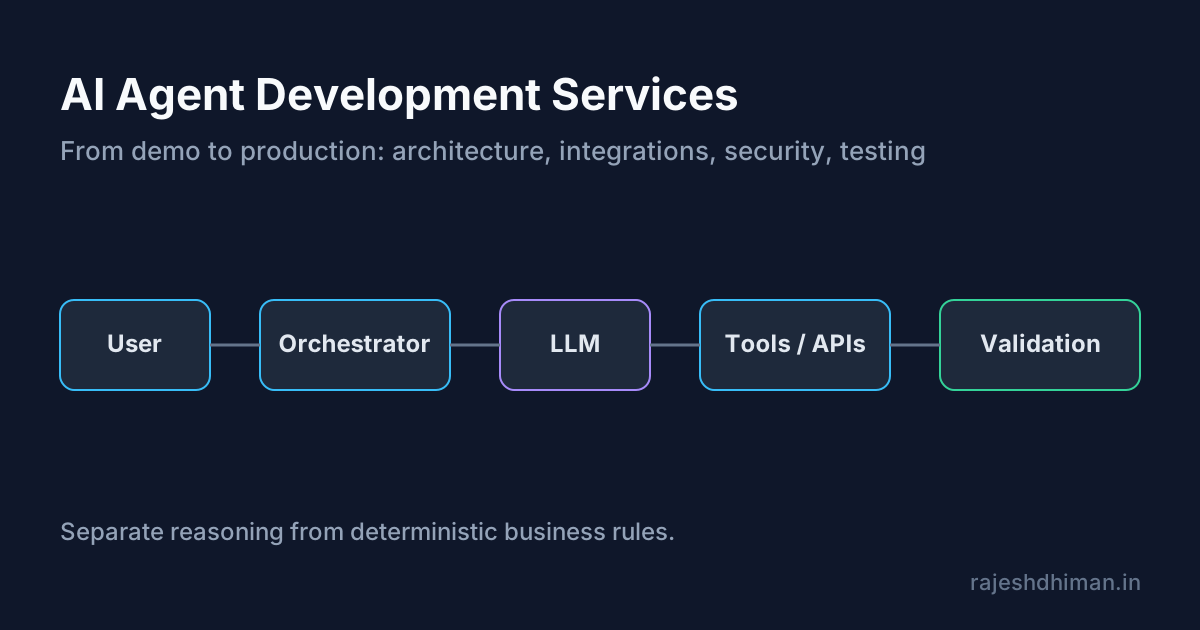
Explore AI agent development services for building reliable, production-ready AI agents. Learn about architecture, integrations, security, testing, deployment, and costs.
The eight metrics to track after implementing AI workflow automation, how to measure each one, and how to turn them into a payback number your team trusts.
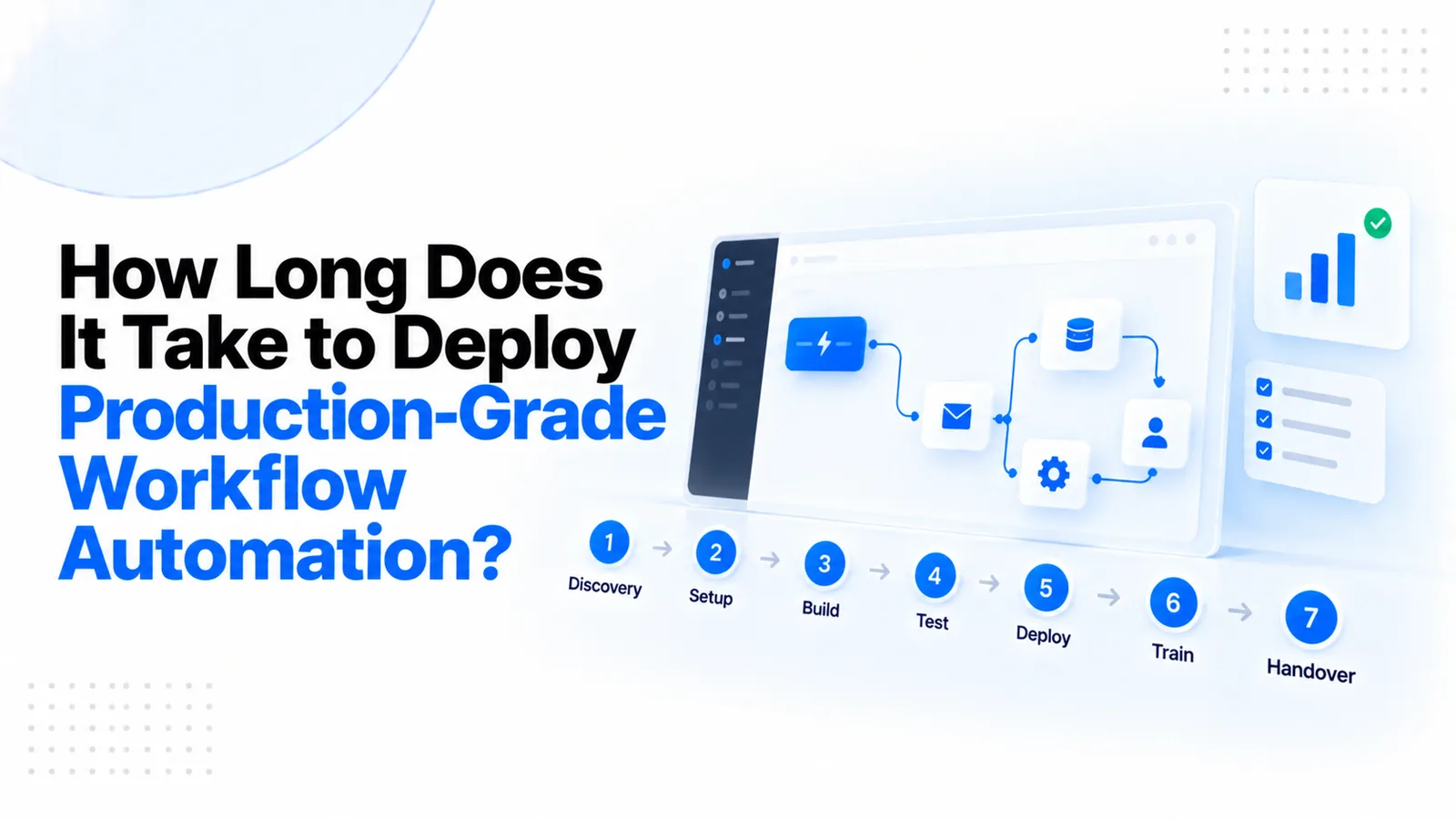
A realistic timeline for deploying production-grade AI workflow automation: 10 days for two well-scoped workflows, longer for multi-system integrations, and what adds weeks.
Stuck on a web app, automation, or AI project?
Fifteen minutes, free. You describe the blocker, I tell you what I would fix first. No deck, no pitch — and if I am not the right fit, I will say so.
Book Your Free 15-Min Strategy CallRelated to: AI Automation Agency vs In-House Development: Which Approach Is Right for Your Business?